
The short version: when it comes to sound quality, DJ room acoustic treatment and speaker placement change what you hear far more than swapping your DJ mixer, your DAC or (within reason) your studio monitors. Fix the room first. Then argue about mixers.
The great mixer debate (and the elephant in the room)
You know the thread. Somebody asks which rotary mixer has the “warmest” bottom end. Forty replies later we’ve covered op-amp lineage, the mystical properties of discrete transistors, whether the 1990s version of a certain mixer sounded “more analogue” than the reissue, and one man who swears he can hear the difference between power cables. Nobody has asked the only question that matters:
What does the room look like?
Because the answer, nine times out of ten, is: a box. Four bare plastered walls, parallel to each other like sentries. A laminate or tiled floor. A ceiling exactly as flat as the floor. Nothing soft anywhere except maybe a beanbag nobody sits on. The monitors are jammed against the back wall either side of a desk, and the DJ is sitting dead centre of the room because that’s where the desk fits.
The hi-fi world is, if anything, worse. People will spend the price of a small car on a pair of speakers, a valve amp and a turntable with a platter you could use as a ship’s anchor, then set it all up in a pristine, minimalist, symmetrical lounge with a polished concrete floor and floor-to-ceiling glass. It looks fantastic in the magazine. It sounds like a squash court.
This article is a friendly intervention. We’re going to look at what rooms actually do to sound, how big those effects are compared with the gear we obsess over, whether your ears really “adjust” to it all (spoiler: partly, and not where it counts), and how to sort out your DJ room acoustic treatment on any budget. There will be diagrams. There may be mild ridicule. It’s all said with love.
How big is “big”? A quick reality check
Audio people argue in decibels, so let’s keep score in decibels. A quick primer for the non-nerds: dB is a log scale, so small numbers do a lot of work. 1 dB is about the smallest broad change most people can pick out in a careful A/B. 6 dB is double the sound pressure. 20 dB is ten times the pressure, which is the difference between a bass note being there and not being there.
Now, a competent line-level mixer, interface or DAC is typically flat to within a decibel or so across the audible range (have a look at the spec sheet of yours). Whatever differences people hear between two good mixers live in that tiny sliver, plus the much bigger effects of EQ curves, gain staging, filter design and, let’s be honest, the price tag.
Here’s what the room is doing at the same time:
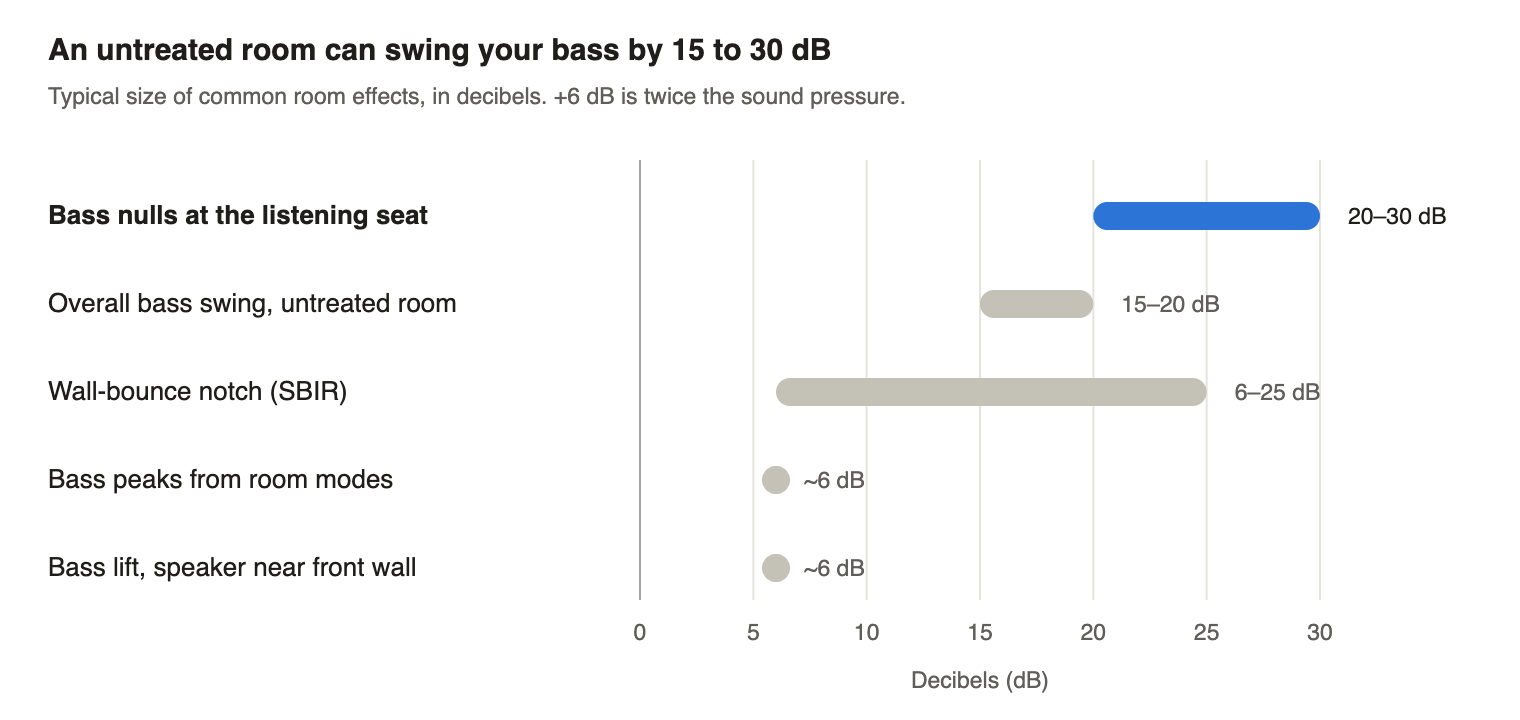
Read that again. In an untreated small room, the bass you hear at your seat can be wrong by 20 to 30 dB at certain notes. Acoustician Ethan Winer puts it bluntly: in home-sized rooms the peaks are generally 6 dB or less, but the nulls (the holes) are often 20–30 dB or even more, and they’re the bigger problem. Independent measurements of typical living rooms show a 15–20 dB wobble across the bass as completely normal.
So when someone tells you mixer A has a “tighter low end” than mixer B, and they’re listening in a box room with bare walls, they are trying to hear a whisper during a fire alarm. The room is the fire alarm.
Room acoustics 101: what your room is actually doing to the music
The most useful single idea in small-room acoustics comes from Floyd Toole, the former Harman research boss who has spent decades studying loudspeakers in real rooms. His point: in a listening room, speakers and room behave differently above and below a transition region of roughly 200–300 Hz. Below it, the room’s resonances dominate the sound. Above it, what matters is how you hear reflections.
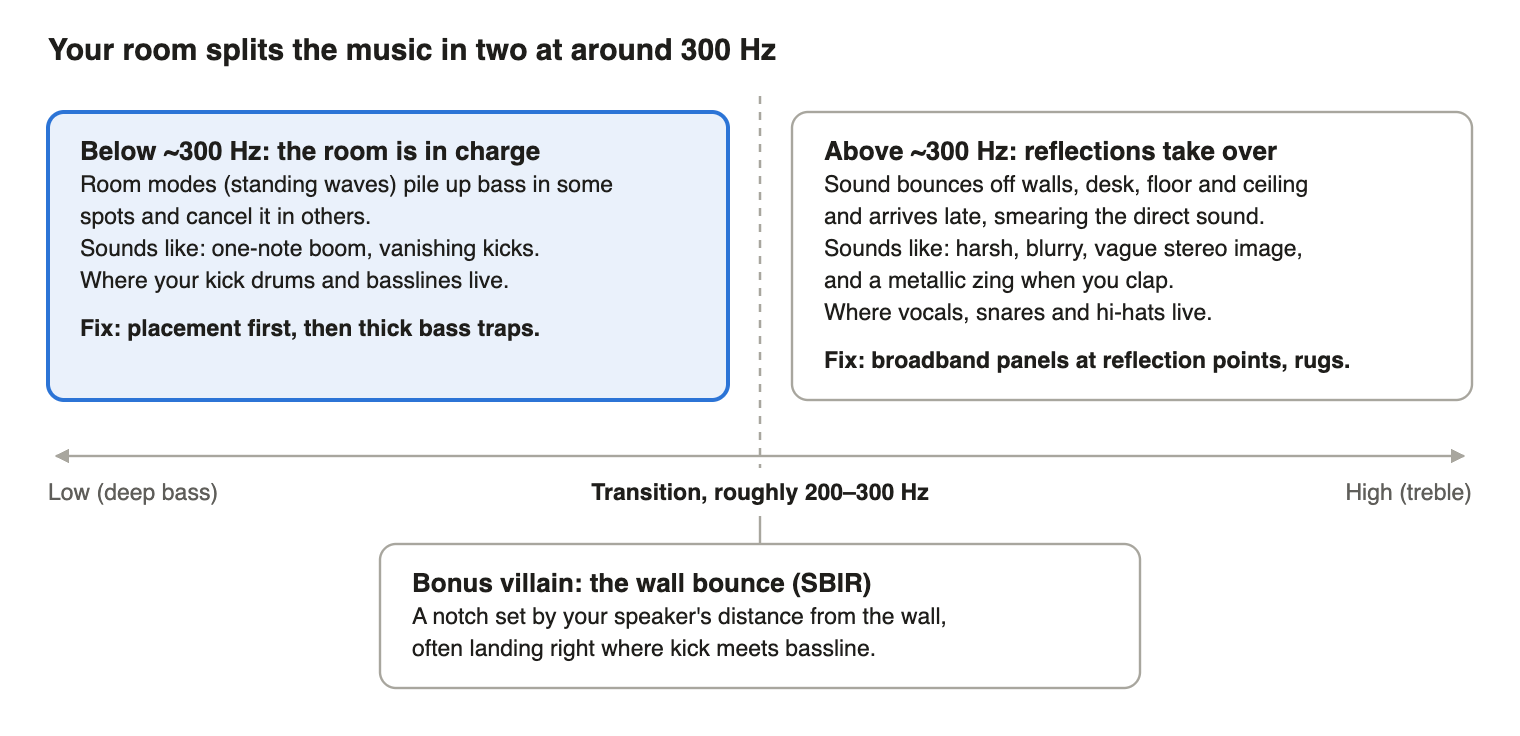
That’s two very different problems, with two very different fixes. Let’s meet the villains.
Villain 1: Room modes (the bass bully)
Bass wavelengths are enormous. At 50 Hz a single wave is about 6.9 m (22.6 ft) long; at 20 Hz it’s over 17 m. That’s bigger than most bedrooms, which means the bass doesn’t so much fill your room as slosh around in it like water in a bath. Waves bounce between parallel surfaces and reinforce or cancel each other, creating fixed patterns of peaks (too much bass) and nulls (bass that just disappears).
Most rooms have their main resonances somewhere between 20 and 200 Hz, which is a polite way of saying “exactly where every kick drum, sub and bassline you’ve ever played lives.” And it isn’t only at the neat frequencies a room-mode calculator spits out: the folks at RealTraps found that small rooms have peaks and severe nulls right across the low end. Move your head a foot and the bass changes. Walk to the corner and it doubles. That’s not your mixer.
Villain 2: Early reflections (the smear merchant)
Above the transition, sound behaves more like light. It leaves the speaker, hits the side wall, the desk, the ceiling, and arrives at your ears a few milliseconds after the direct sound. Your brain fuses them, but the mix of direct and delayed copies causes comb filtering: a pattern of tiny cancellations that blurs detail, smears the stereo image and gives everything a slightly hard, glassy edge. The top of your DJ mixer or controller is a prime suspect here too, as the EBU’s own guidance on listening rooms points out about mixing desks.
Villain 3: Flutter echo (the zing)
Stand in the middle of your room and clap. Hear a fast metallic “zzzing” or a sort of spring-reverb buzz? That’s flutter echo: sound pinging back and forth between two parallel, hard surfaces. It’s at its worst halfway between those surfaces and along bare walls with nothing to break up the path. It’s the same effect that makes school gyms sound like school gyms.
Bonus villain: SBIR (the wall bounce)
Speaker Boundary Interference Response sounds like a medical condition and behaves like one. Bass leaves the back and sides of your monitor, bounces off the wall behind it and comes back out of phase with the sound leaving the front. Result: a notch whose frequency depends on the distance to the wall (the wall distance is a quarter of the cancelled wavelength). Sonarworks puts the dip at anywhere from 6 to 25 dB. Speaker 1 ft (30 cm) from the wall? The notch lands around 285 Hz. Two feet out? Around 140 Hz. About a metre? Down around 86 Hz, right where the kick drum thumps. And because it’s a cancellation, EQ can’t fix it: pump more energy in and you just get more cancellation.
Square rooms, bare floors and the centre-seat trap
Now we get to the bit that makes acousticians weep quietly into their measurement mics. Here’s what the lowest two front-to-back resonances look like in a typical room:
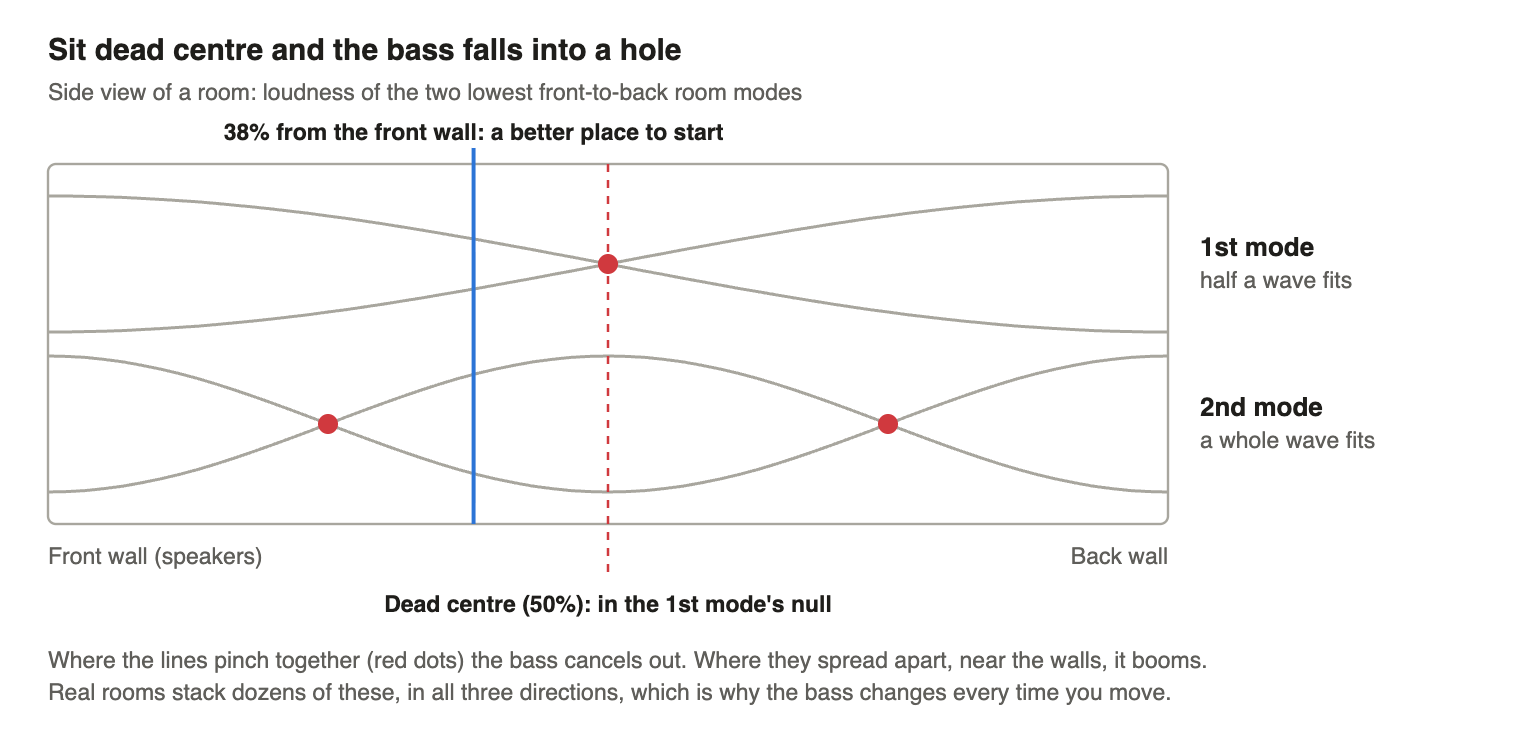
See where the classic “desk in the middle of the room” DJ sits? Right in the hole. Bass pressure is always at its maximum at the walls and, for that first mode, cancels completely at the halfway point. That’s why so many bedroom DJs think their monitors are “a bit thin”, crank the low EQ, and then wonder why their recorded mixes sound like a bouncy castle on everyone else’s system.
The 38% rule (a starting point, not scripture)
Acoustician Wes Lachot popularised the idea that the best compromise seat in a rectangular room sits about 38% of the room’s length from the front wall (or from the back wall in smaller rooms), dodging the worst of the peaks and nulls. It’s not magic: there are other modes in play, and plenty of acousticians will tell you to measure your own room rather than trust any rule of thumb. But as a first move it costs nothing and frequently does more than a mixer upgrade. One forum user summed up the typical result: moving the seat to 38% “greatly reduced a booming bass problem”.
Why square and symmetrical rooms are the worst
Let’s clear up one thing: left-to-right symmetry is good. Your speakers should sit symmetrically in the room so both channels get the same treatment from the walls. What’s bad is when the room’s dimensions match each other.
Every dimension of a room has its own set of modes. In a nicely proportioned room those modes are spread out, so no single note gets hammered. In a square room, length and width produce the same modes, so they stack on top of each other. In a cube, all three dimensions pile onto the same frequencies. Acousticians are unusually unanimous on this: a cube is the worst realistic room shape there is, with all three pairs of surfaces parallel and identical, and flutter echo waiting to dominate the listening experience unless it’s treated.
Acousticians have worked out “good” ratios for height : width : length that spread the modes out evenly. A few classics:
| Ratio name | Height : Width : Length | Example for a 2.4 m ceiling |
|---|---|---|
| Bolt | 1 : 1.4 : 1.9 | 2.4 × 3.4 × 4.6 m |
| Sepmeyer | 1 : 1.6 : 2.5 | 2.4 × 3.8 × 6.0 m |
| Square floor plan (bad) | 1 : 1.5 : 1.5 | 2.4 × 3.6 × 3.6 m |
| Cube (worst) | 1 : 1 : 1 | 2.4 × 2.4 × 2.4 m |
You probably can’t knock walls down, but if you have a choice of rooms, pick the one that’s least square. And if you’re stuck with a square one (hello, hi-fi showroom aesthetic), treatment stops being optional.
And the hard floor?
A bare floor and a bare ceiling are just another pair of parallel mirrors. Tiles, laminate, polished concrete and a flat plaster ceiling bounce sound straight back up and down between them, feeding flutter echo and a strong floor reflection into your ears from every speaker. A thick rug between you and the speakers is the cheapest acoustic treatment ever invented. You’re welcome.
“But don’t your ears just adjust?”
Ah, the classic. It usually arrives right after someone’s been shown a measurement of their room looking like the Alps. And here’s the annoying part: it’s half true. Which is exactly what makes it such a good excuse.
What your brain genuinely does compensate for
Your hearing is not a measurement microphone, and thank goodness. A few things are well established:
- You separate the room from the source. Floyd Toole notes that humans evolved listening in reflective spaces and are comfortable in them. We mentally “stream” the room’s sound separately from the instrument or speaker. As he puts it, two ears and a brain are much smarter than a microphone and an analyser.
- You lock on to the first arrival. The precedence effect means a reflection that arrives soon enough after the direct sound gets fused into one image, rather than heard as an echo. The image may shift or stretch a little, but it stays put.
- You adapt to a room’s reverb, fast. Lab studies by Pavel Zahorik and colleagues found that after brief exposure to a room, speech gets noticeably easier to understand: an improvement of up to around 20% in intelligibility, happening within about a second, strongest in rooms with moderate reverb and needing both ears.
- You can still tell speakers apart in different rooms. In Toole’s multi-room tests, listeners rated loudspeakers consistently across very different rooms. “Loudspeaker” mattered statistically; “room” didn’t.
So yes: within limits, your brain is very good at hearing through a room’s reflections. That’s why you can follow a conversation in a kitchen.
What it can’t do
Now read the small print on all that research:
- It’s mostly about reflections and speech, not bass tone. The adaptation studies measure how well people understand words in reverberant rooms. Nobody’s claiming your brain refills a 25 dB hole at 60 Hz. Toole himself draws the line at the transition frequency: below it, room resonances dominate the sound quality, and the problem he highlights there is the “booms” and ringing of a few under-damped modes. Even he sums it up with: we get used to what we have, “up to a point”.
- Getting used to it isn’t the same as hearing it correctly. Adapting means your brain stops noticing the problem. It does not mean the problem stops affecting your decisions. If you’ve “adapted” to a room with no 60 Hz, you’ll keep pushing the low EQ to find it, and the room will keep swallowing it.
- You can’t adapt to a hole that moves. Bass peaks and nulls shift dramatically as you move, even between your two ears. Lean over the decks and the bass changes. Your brain has nothing stable to calibrate to.
- Too much reflection breaks the trick. The precedence effect only works up to a point. Above that threshold you hear two images instead of one, and Toole calls that a problem. Flutter echo and strong desk reflections sit right in that zone.
The honest verdict: your ears compensate for the room’s character, not its mistakes. A bit of liveliness from reflections is natural and even pleasant; Toole argues a room can have too few reflections as well as too many. But the bass chaos below 300 Hz is not something your brain quietly fixes. It’s something you mix around, EQ around and argue about on forums, usually while blaming your mixer.
Why room acoustics matter more for DJs than most
Audiophiles sit and listen. DJs make decisions, hundreds of them an hour, and almost all of them depend on hearing the low end properly.
- Beatmatching lives in the bass. You’re locking kicks and basslines together. If your seat sits in a null at the kick’s fundamental, you’re riding the pitch fader by ear on a signal that’s half missing. People fall back on the waveform display, then wonder why their ears feel out of practice in the club.
- Your EQ moves are lies. Kill the bass on the outgoing track and bring it in on the incoming one in a room with a 20 dB peak at 50 Hz and a hole at 80 Hz, and you’re mixing the room, not the records. The same blend on a club rig will sound completely different.
- Recorded mixes and streams travel. Every mix you record or stream gets judged on earbuds, car stereos and other people’s living rooms. Mix in a room with a bass hole and you’ll over-cook the low end on everything. Mix in a boom and everyone else gets thin, weedy transitions.
- Volume creep is real. A room that eats your bass and blurs your detail tempts you to turn it up. More level means more of the room’s problems, more fatigue and, over years, real risk to the one bit of kit you can’t replace: your hearing.
- Bad acoustics make the neighbours hate you more. Treatment won’t soundproof a room (nothing short of building a room inside a room will), but a room that sounds right at lower volume is a room you don’t need to blast.
There’s a fair counter-argument, made by Digital DJ Tips among others: real gigs rarely have great acoustics, so practising in an imperfect room isn’t the end of the world. True. But a club has a proper PA, a booth monitor and an engineer (usually). Your bedroom has you, two monitors and a wardrobe. You want your home setup to tell you the truth about the music, so you learn to recognise when a venue is lying to you.
“I’ll just use room correction software” (Sonarworks, Dirac and co.)
Room correction (Sonarworks SoundID Reference, Dirac Live, IK ARC, Trinnov and the EQ built into many monitors) is genuinely useful. It’s also routinely oversold. A few hard truths:
- It only fixes one spot. EQ applies to the whole room, but the room’s response is different everywhere. Room EQ Wizard’s own documentation explains that a measurement is only valid where the mic was, so a correction that’s perfect at one point can make things worse elsewhere. Ethan Winer’s tests found a boost that fixed a null at the main seat made the response much worse only one seat away, and that peaks and nulls are so localised in home-sized rooms that EQ can’t even get the same response at both ears.
- It can’t fill holes. A null is a cancellation, so adding energy just adds cancellation. Dirac’s own chief scientist, Mathias Johansson, confirmed that narrow dips are never compensated because they are always position dependent. Same goes for SBIR notches.
- It can’t change how much a wall reflects. EQ changes what the speaker sends out; it doesn’t make the side wall any less of a mirror or stop flutter echo.
Where it shines: taming peaks. Room booms (the bit Winer reckons is usually 6 dB or less) respond well to a gentle cut. So the professional order of operations is: placement → acoustic treatment → room correction as the final polish. Use it to tidy up, not to rescue a squash court.
DJ room acoustic treatment: the WAXWRX order of operations
Good news: you don’t need a professional studio build. You need to do the right things in the right order, and stop buying the wrong things first.
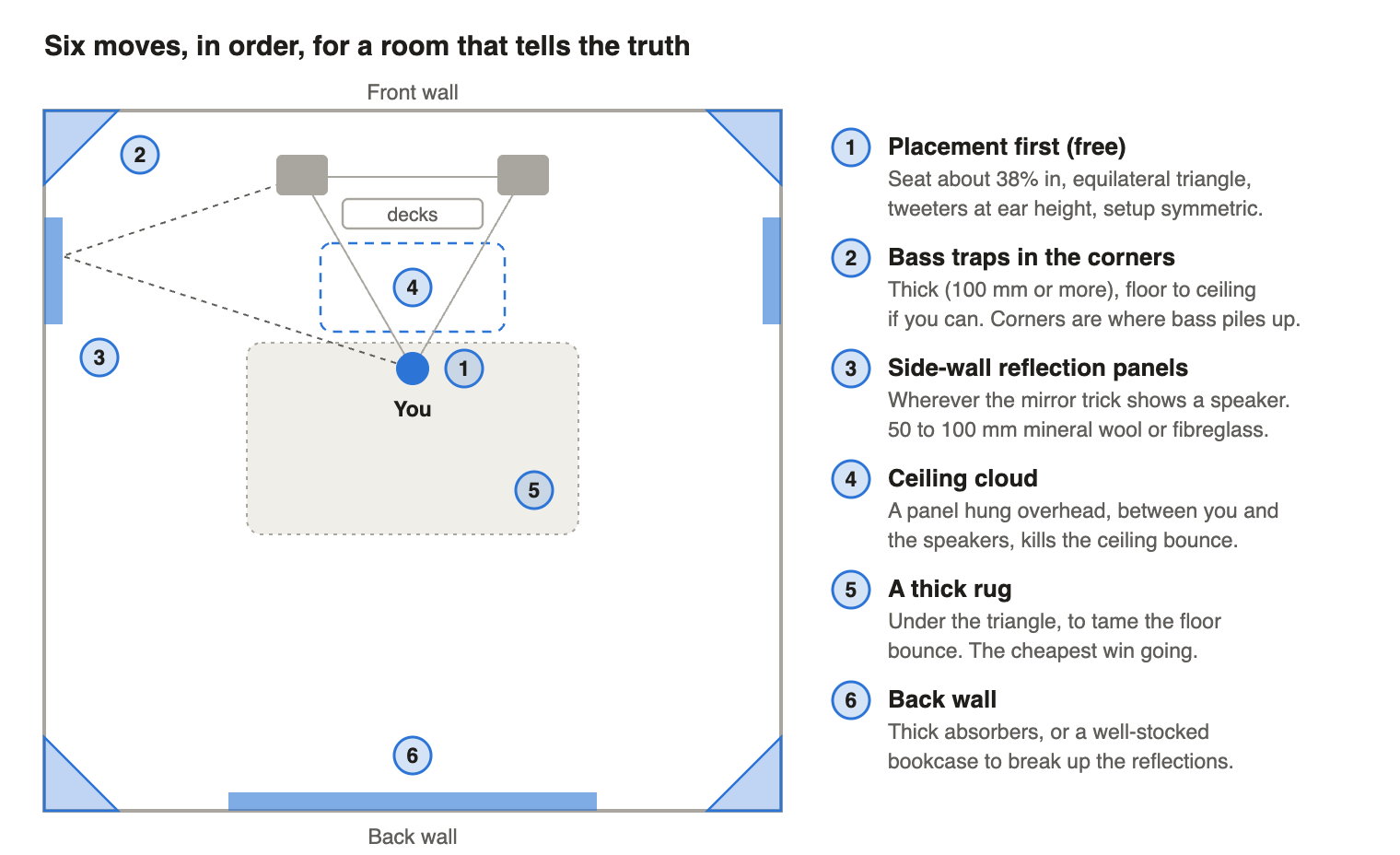
1. Placement (costs nothing, fixes loads)
- Face the long way. Set up along the longer dimension of the room, firing down its length, centred between the side walls.
- Get out of the middle. Try the 38% position, then move your seat in small steps while playing a bass-heavy track or a slow low-frequency sweep. Listen for where the kick sounds most even.
- Equilateral triangle. Speakers and your head form a triangle with equal sides, tweeters at ear height, angled at you.
- Mind the wall gap. Either get the speakers close to the front wall (and use the rear-panel “boundary” or low-shelf switch to cut the extra bass), or well out into the room. The awkward middle distance is where SBIR notches land in the bass.
- Decouple them. Get monitors off the desk and onto stands or isolation pads, so the desk doesn’t become a resonating drum, and so the desk surface isn’t throwing reflections straight up into your face.
2. Bass traps in the corners
This is the big one, and the one people skip. Bass pressure piles up at room boundaries and corners, so that’s where absorbing it is most effective. Auralex’s advice is to start any small room by putting bass traps in all the corners. Thickness is everything: a common rule of thumb from Ethan Winer is at least 100 mm (4″) for bass trapping and 50 mm (2″) for reflection points. Low bass is hard: even six inches of fibreglass does little at 100 Hz, so more depth, more coverage and an air gap behind the panel all help. Floor-to-ceiling front corners first, then the rear, then the wall–ceiling corners if you’re going all in.
3. First reflection points (the mirror trick)
Sit in your DJ spot. Get a mate to slide a mirror flat along the side wall. Wherever you can see a speaker in the mirror, mark it: that’s a first reflection point. Do both walls, then repeat for the ceiling if you can. Cover those spots with broadband absorbers: rigid mineral wool or fibreglass panels, fabric-wrapped. Think of them as reflection zones rather than pin-points; a 60 × 120 cm panel centred on the mark is a sensible minimum.
4. Ceiling cloud
The ceiling is a big flat mirror directly between you and the speakers. A panel suspended above the gap between your head and the monitors deals with it and looks cool in photos.
5. Rugs, curtains and the soft stuff
Rugs, heavy curtains, a sofa, a bookcase full of records (fitting, that). None of these will fix the bass, but they break up flutter echo and cut the bright, splashy reflections cheaply. Records on shelves are, scientifically speaking, the most on-brand diffuser available to a DJ.
6. Back wall
In small rooms, put more thick absorption on the back wall; the reflection from right behind you arrives quickly and is often loud. In bigger rooms, diffusion (or that bookcase) can keep things lively without smearing the sound.
A word about egg-box foam
We need to talk about those 12 × 12 inch packs of thin pyramid foam. They do something, just not the thing you need. Sound On Sound points out that even 4″ foam only absorbs effectively down to around 1 kHz, and 2″ foam mostly works above 2–3 kHz. Plaster your walls with it and you strip out the treble while leaving every bass problem fully intact. The result is the dreaded “boxy” room: dead at the top, boomy at the bottom. If you’ve already bought it, it’s fine on a ceiling or to stop a flutter echo, but spend the next pound on proper thick panels and corner traps.
And for the avoidance of doubt: none of this is soundproofing. Acoustic treatment changes how a room sounds inside. Stopping sound getting out needs mass, sealing and decoupling, which is a building project, not a panel.
DJ room acoustic treatment on any budget: what to do this weekend
| Budget | What to do | What you’ll notice |
|---|---|---|
| Nothing | Turn the setup to fire down the long wall. Move your seat off centre (try 38%). Equilateral triangle. Pull speakers off the desk onto stands, books, anything. Clap test for flutter. | Steadier, fuller bass; a clearer centre image. Often the biggest single jump. |
| Pocket money | A thick rug, heavy curtains, a bookcase of records on the back wall, a sofa or bed doing its bit. | Less splash and zing; the room stops sounding like a bathroom. |
| Less than a new pair of headphones | DIY panels: rigid mineral wool or fibreglass slabs in a timber frame, wrapped in breathable fabric. Start with corner traps and the side-wall reflection points. | Tighter kicks, basslines that don’t vanish when you lean in, mixes that translate. |
| Less than a mid-range mixer | Commercial broadband panels and proper corner traps, a ceiling cloud, then room correction software as the final polish. | A room you can actually trust, at lower volume. |
The closing argument
Next time the forum lights up with “which mixer has the punchiest low end?”, ask to see a photo of the room. If it’s four bare walls, a tiled floor and a desk in the dead centre, you already know the answer: neither of them, not in there.
The gear matters. Of course it does, and I’ve had plenty to say about it in My views on DJ mixers and DJ mixers are bad for your health. But in a typical untreated small room, the room is shaping the bass by tens of decibels while the mixers are arguing over fractions of one. Your ears are brilliant at listening through a room’s reflections, but they won’t fill in a missing bassline, and they won’t stop your hands reaching for the EQ to chase it.
So before your next upgrade, put the money into DJ room acoustic treatment instead. Do the free stuff first. Then put a bass trap in the corner. Then, and only then, argue about mixers. We’ll bring the popcorn.
Sources and further reading
- Floyd Toole, Loudspeakers and Rooms for Sound Reproduction: A Scientific Review (AES, 2006): aes2.org
- Floyd Toole, Room Reflections & Human Adaptation for Small Room Acoustics: audioholics.com
- Floyd Toole, History of Multi-Sub & Sound Field Management: audioholics.com
- Ethan Winer, Assessing Room Correction Products: Dirac and Acourate: prosoundweb.com
- RealTraps, A New Approach to Small Room Acoustics: realtraps.com
- RealTraps, How to Set Up a Listening Room: realtraps.com
- Archimago, Audiophile small room acoustics: complex and essential (April 2026): archimago.blogspot.com
- Zahorik & Brandewie, Perceptual Adaptation to Room Acoustics and Effects on Speech Intelligibility: pmc.ncbi.nlm.nih.gov
- Zahorik, Room adaptation and speech understanding (ICA 2019): pub.dega-akustik.de
- Sonarworks, Should you place speakers against the front wall?: sonarworks.com
- Sonarworks, SBIR glossary: sonarworks.com
- Room EQ Wizard, Why can’t I fix all my acoustic problems with EQ?: roomeqwizard.com
- Dirac Room Correction Interview with Mathias Johansson: audioholics.com
- Sound On Sound, on acoustic foam: soundonsound.com
- TV Technology, Low-Frequency Sound and Room Acoustics: tvtechnology.com
- TV Technology, Proper Loudspeaker Placement: tvtechnology.com
- ProSoundWeb, room geometry and cubes: prosoundweb.com
- Vicoustic, What Is Flutter Echo?: vicoustic.com
- GIK Acoustics, Early Reflection Points: gikacoustics.com
- Auralex, room treatment basics: auralex.com
- Wikipedia, Room modes: en.wikipedia.org
- Digital DJ Tips, Why Soundproofing Your DJ Room Won’t Work: digitaldjtips.com
Leave a Reply